Asurini do Tocantins
- Self-denomination
- Asurini
- Where they are How many
- TO 671 (Siasi/Sesai, 2020)
- Linguistic family
- Tupi-Guarani
The Asuriní say the universe was first created, but then it was flooded and the earth ceased to exist, 'it became soft.' From this misfortune, only one man survived, sheltered at the top of a bacabeira tree. It was then that Mahira summoned tapir for the animal to harden the surface of the earth. Mahira also extracted his own rib, transforming it into a woman, which allowed the human population to increase.
Name
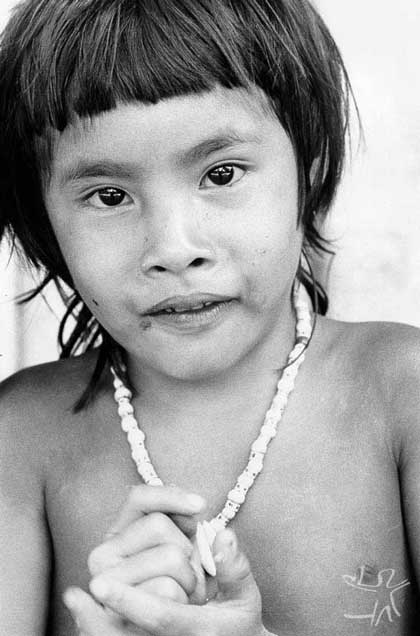
The term Asuriní derives from the Juruna language and has been used since the 19th century to designate various Tupi groups living in the region between the Xingu and Tocantins rivers. The term began to be employed to name this particular people in the 1950s by agents of the SPI (Serviço de Proteção aos Índios - Indian Protection Service) during the process of pacification. The Asuriní of the Tocantins are also known as the Asuriní of the Trocará (the name of their indigenous territory) and the Akuáwa-Asuriní. This latter name was used by the ethnologist Roque Laraia in the 1960s, as the researcher considered the term Akuáwa to be the group's autodenomination.
However, the people have adopted the term Asuriní as their autodenomination for a number of years now. In contrast, as the anthropologist Lúcia Andrade confirmed in the 1980s, Akuáwa has acquired a pejorative connotation, being used to designate 'Indians of the forest' or 'wild Indians,' meaning those only recently contacted.
Language
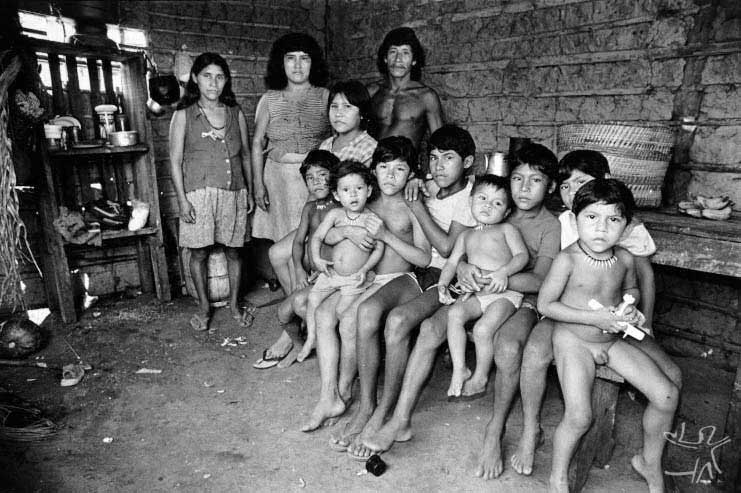
The Asuriní speak a Tupi-Guarani language, studied by the linguists Carl Harrison, Robin Solly and, more recently, Velda Nicholson, Catherine Aberdour and Annette Tomkins, all from the Summer Institute of Linguistics (SIL, called Sociedade Internacional de Lingüística in Brazil). According to Harrison (1980), various dialectical differences exist between the Asuriní language spoken by the Trocará group and the group found on the Pacajá. In his opinion, such differences suggest that contacts between the two groups, by then residents of a single village, were previously intermittent. In 1962, the members of the Pacajá group were basically monolingual, while the Asuriní living at the Trocará Indigenous Post (IP) already spoke Portuguese, learnt from the Post workers and their families, as well as from neighbours on the Tocantins river who visited them sporadically. By 1973 all the Asuriní children and youths living at the Trocará IP spoke only Portuguese, while all the members of the Pacajá group spoke the indigenous language. Today practically all the Asuriní speak Portuguese fluently, younger people and children communicating almost exclusively in this language.
Location
Information from the Asuriní indicates the Xingu river as the region they came from, where they used to live with the Parakanã, comprising a single people in the past. It is surmised that during the first decades of the 20th century, the Asuriní abandoned the Xingu region, motivated by a series of internal fissions and conflicts with other indigenous peoples. As a result, they relocated towards the east, occupying the headwaters of the Pacajá river and later the shores of the Trocará river, where they are found until today.
Currently, they live in the Trocará Indigenous Territory, 24 kilometres to the north of the centre of Tucuruí municipality (Pará), in which they are located. Administrative demarcation of the 21,722 hectares of this Indigenous Territory was approved by the Decree no. 87,845 of 22nd November 1982, registered in the Tucuruí land registry and the Federal Heritage Service.
The Trocará IT is traversed north to south across its entire length by the BR-153 which thereby divides the area into two parts. The village and the FUNAI post are located to the east of the road, in the section bordered by the Tocantins river. The area situated to the west is a rectangle of forest comprising one of the region's last vestiges of primary tropical rainforest.
The Trocará IT is set within the region covered by the Grande Carajás Project, which includes Maranhão State and parts of Pará and Tocantins. This immense mineral-metallurgical exploration program, developed in conjunction with a series of infrastructural works (such as the Tucuruí hydroelectric plant and the railway linking the Serra dos Carajás with São Luís), has led to radical changes in the socio-economic structure of the region inhabited by the Asuriní.
The Tucuruí Hydroelectric Plant, located about 30 kilometres upriver of the Trocará IT, completely transformed the municipality. Its construction between 1975 and 1984 entailed the influx of thousands of people into the region. Thus between 1970 and 1980, Tucuruí's annual growth rate was 22.7%, while during the same period Belém presented an annual growth rate of 3.3%. The Asuriní territory was not flooded by the Tucuruí HEP reservoir. Located downriver of the dam, the Asuriní suffered what was conventionally called 'indirect effects,' that is, the consequences of the deep transformations in the region's socio-economic structure and the sweeping ecological change resulting from the project's construction.
These transformations include the installation of a series of farm-holdings in the region. The Trocará IA is now completely surrounded by cattle ranches and comprises one of the few remaining areas of forest in the municipality.
The deforestation surrounding the indigenous reserve has had a negative impact on the fauna within the Asuriní territory. As a result, the Indians complain that that hunting is increasingly difficult as many species can no longer be found there. At the same time, the Trocará IA's forest attracts numerous outside hunters who constantly invade the indigenous territory.
Another indirect effect of the hydroelectric plant and the accelerated occupation of the region was a large increase in the incidence of malaria among the Asuriní, which was the group's main health problem in 1985.
Population
The table below shows how the Asuriní of the Tocantins population evolved after its initial contacts with the government indigenist body.
| Year | Pop. at the post | Source |
| 1953 | 190 | Laraia 1979 |
| 1955 | 66 | Arnaud 1961 |
| 1961 | 26 | Arnaud 1961 |
| 1962 | 35 | Laraia 1979 |
| 1970 | 48 | Trocará IP archive |
| 1976 | 92 | Vidal 1980 |
| 1980 | 106 | Vidal 1980 |
| 1952 | 120 | Andrade 1982b |
| 1984 | 132 | Andrade 1984b |
| 1990 | 191 | Funai 1990 |
| 1994 | 225 | Funai 1994 |
As the above table shows, the Asuriní population remained below 100 individuals until approximately 1976-1977. This sudden growth partly resulted from the arrival in 1974 of the Asuriní who lived on the Pacajá river. After this date, continual demographic growth has been recorded, so that by 1984 children up to the age of 14 already made up approximately 55% of the population. At the time of contact (1953) the Asuriní population numbered 190 individuals. However, before the end of this year more than 50 people had died as victims of influenza and dysentery. After the epidemic, most of the Indians returned to the forest. In 1956, after a clash with the head of the FUNAI Post, the group that had stayed at the Post also retreated to the forest. Two years later, the remaining members of this group returned. At the beginning of 1962, the Pacajá group, who had first abandoned the Trocará IP, also returned to the site. At this period there were about 30 people; however, influenza and dysentery once more devastated the group: its 14 survivors fled to the forest, leaving 7 orphans at the Post.
History of contact
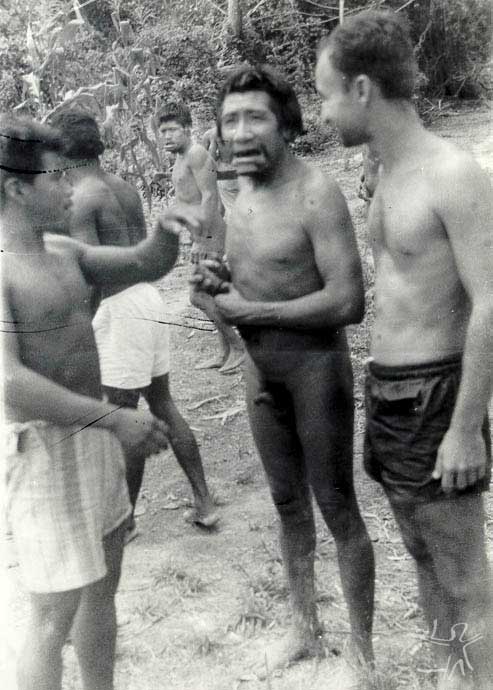
The Asuriní of the Tocantins first appear in the historical archives in the context of the advance of the colonizing front at the start of the 20th century, in the region above the Itaboca Waterfall (now covered by the Tucuruí HEP reservoir).
From the 1920s onward, the region from Marabá to Tucuruí became an important area for commercial Brazil nut harvesting. With the aim of ensuring transportation of the Brazil nut harvests from Marabá to Belém, the decision was made to build the Tocantins Railroad, which would by-pass the twelve kilometres of rapids on the Tocantins river, uniting the localities of Tucuruí (known at the time as Alcobaça) and Jatobal. This railway crossed the territory of the Asuriní and Parakanã, who reacted vehemently to the invasion.
The Tocantins Railroad was begun in 1895 and partially completed only in 1945. In 1935, only about 67 kilometres had been built of the 117 initially planned. Conflicts between Indians and railroad workers erupted at the end of the 1920s. In 1928, after a raid organized by the engineer Amyntas Lemos that resulted in the death of eight Indians, the Asuriní intensified their attacks against the regional population. Two years later, the Asuriní attacked and killed Brazil nut harvesters close to the place called Joana Peres. In May of the same year (1930), they killed another two people. Then in 1933 they retaliated against a police railcoach, killing and plundering the party on the 14 kilometre point of the railway. In 1937, the Asuriní came into contact with employees of the SPI. Soon after, however, they were attacked by railroad workers and in reprisal invaded a cabin, killing two people and injuring a third.
In 1945, the director of the Tocantins Railroad and the special delegate of the Tucuruí police organized an armed expedition against the Asuriní. A massacre was only averted because the Indians were unable to be found by their pursuers. The SPI filed a law suit against the engineer, but the denunciation was thrown out as inadmissible by the Cametá judge.
In 1948, the Asuriní entered into contact with the regional population, in the village called Cachoeira de Itaboca, but were repelled by gunfire and pursued through the forest for two days. In 1949, the Asuriní killed a woman on the 52km of the railway, and a worker on the 18km. In the same year, they attacked the SPI cabin located on the 67km, injuring an employee.
1949 was one of the most critical years in the ongoing conflict. The small farm holders eventually abandoned their plantations and the railway maintenance teams could only work under the protection of armed guards. During the year, the SPI intensified its attempts to contact the Asuriní, eventually achieved four years later.
Official contact between the Asuriní and the SPI 'attraction team' took place in March 1953, at a place called the 'Apinajé site,' between the Piranheira and Trocará creeks, close to the area they occupy today.
The Asuriní's decision to seek out the SPI encampment seems to have been motivated by their conflicts with the Parakanã. A large Parakanã attack probably led one of the Asuriní groups to look for help from the attraction team's employees. This group was made up of 190 Indians who took up residence next to the SPI post. In the same year as this contact, more than fifty Indians died from influenza and dysentery. This period is described by the Asuriní as a period during which they did not even have time to bury all their dead.
Most of the survivors of the catastrophe caused by contact returned to the forests in the same year of 1953. Only a small group remained with the SPI until 1956. However, in this year they decided to leave the post due to a fallout with the SPI employees, coming back two years later in 1958.
Then in 1962, the second Asuriní group which had remained in the forest reappeared at the SPI post. Again, influenza provoked a series of deaths and the survivors decided to return once more to the Pacajá region. When the anthropologist Roque Laraia visited the Asuriní in 1962, he encountered a population of 35 Indians. Laraia observed that the Asuriní were living in a situation of extreme dependency on the employees of the Trocará post, while going through a phase of profound social disorganization as a result of the drastic reduction in their population.
At the same time, the group that had returned to the Pacajá region found themselves without any assistance from the indigenist body, living on hunting, fishing, agriculture and small-scale commercial trading with the regional non-indigenous population. The group remained in the region of the middle-upper course of the Pacajá river until 1974 when they moved to the Trocará. All the signs are that the two local groups on the Trocará and the Pacajá maintained intermittent contacts up until the time they came together.
In 1973, researchers from the Summer Institute of Linguistics (Nicholson and Aberdour) visited the Asuriní on the Pacajá and brought a tape recording of the Trocará group inviting them to visit. The invitation, compiled with the difficulties stemming from the lack of government assistance, led the Asuriní on the Pacajá to relocate to the Trocará. According to its reports, FUNAI sent a boat to fetch them in 1974. Since this time the Asuriní have never returned to the Pacajá.
Hunting, fishing and gathering
The food which the Asuriní most enjoy and consider the most nutritious is game meat. They hunt mammals such as tapir, deer and collared peccary, as well as agouti, monkey, paca, armadillo and birds such as tinamous, toucans and curassows. Hunting is preferentially a male activity, but some women also hunt.
Nowadays, the Asuriní hunt with rifles and during the night, since they say that they no longer find animals during the day. They face considerable difficulties in acquiring the rifles, ammunition and batteries required for their torches and have consequently become dependent on FUNAI which only sporadically provides them with an inadequate supply of these materials. On many occasions, the Indians have no meat to eat.
Fishing, which could balance their diet, also appears to be affected by the ecological changes taking place across the whole region. Even so, its importance as a food source for the group is today much greater than during the period prior to contact. Fishing is practised by adult men, as well as less frequently by women and children. They fish with hooks, beaters and fishing nets in the Trocará river and the lakes close to the Tocantins, but rarely in the latter river.
During the months of July and August, until the water level reaches its lowest point, fishing in the lakes close to the village is fairly difficult and only improves at the end of September. During this period, fishing is only worthwhile in the rivers further away from the village: this involves the relocation of the entire nuclear or extensive family, which spends several days camped at some point far from the Indigenous Territory, where they can also find game more easily. It is on these occasions, say the Asuriní, that they eat well and become fatter.
In the months from January to April (the rainy season), the Asuriní gather products such as assai, bacury and Brazil nuts. This is a male activity, though sometimes women help. These products are destined for their own consumption and for sale in Tucuruí; only Brazil nuts, whose production is still at an early stage, are not sold.
The village
All the Asuriní currently reside in a single village, located about three kilometres from the shores of the Tocantins river. In 1988, the village was formed by thirty houses, which sheltered the different nuclear families.
The houses are built from caryota rufflepalm wood, used for the walls and flooring, and ubim straw, employed for the thatching and sometimes also for the walls. The architecture of the houses follows the regional pattern, while some are built on raised platforms. Although more rare, some mud hut are also made. Some 4 or 5 years ago new houses were constructed from wood and roofing tiles, paid for by compensation received for the Trans-Cametá road.
Dwellings are usually divided into three areas: living area, kitchen and sleeping area. Found to the rear of the house are small constructions such as sanitary holes. Some dwellings have more than one sleeping area, one for the couple and the other for children, but most possess just one large room where all the family sleeps. This area is used for sleeping and afternoon naps, as well as for performing tasks such as preparing ammunition and mending clothes, which require some privacy or distance away from children.
Most of the time a house's residents remain in the kitchen-living area. Some houses have a kitchen built a slight distance away, usually in a more open construction without side walls. The kitchen contains a raised worktop and a stove, generally built from an arrangement of bricks, wood and clay. Some families formed by younger couples use gas stoves. The worktop is used to prepare game and other food and to clean dishes. These are hung in a window on the outside of the house so that the water does not drip inside the dwelling.
Domestic utensils are kept on shelves or stuck into the thatching of the walls and roof of the kitchen: plates, knives, cutlery, cups, toothbrushes, fishing line, etc. The area also contains the most sophisticated furniture in the house: the tables and chairs. This is the area used for meals and receiving visitors. Visitors may also be received on the patio in front of the house. In terms of domestic objects, the Asuriní also usually own hammocks (and more rarely beds), cupboards, radios, phonographs and, in some houses, television sets.
Houses are built by men who usually perform the work alone. Construction of a new house may be spurred by the age of the old dwelling or by the desire to change location due to reasons such as a fight with neighbours.
The creeks close to the houses are almost taken to be a domestic space, an extension of the village. The women use these creeks to wash clothing and collect water for the houses. This is also where people bathe. Children spend a large part of the day playing in the rivers. Each residential section uses a particular point on the river course. In the areas between the dwellings and the creeks, small swiddens are usually cultivated with maize, yam, potato, banana and pineapple.
The village's dwellings are constructed in a line along the path running from the FUNAI post to the flour cabin - the latter is located on the village outskirts, that is, on the periphery of social space. Certain clusters of houses making up the residential sections are also found along this main path. Each of these residential units possesses a communal patio, generally in front of the oldest couple's house. In day-to-day terms, these patios mark the spaces of interaction at the village's internal level.
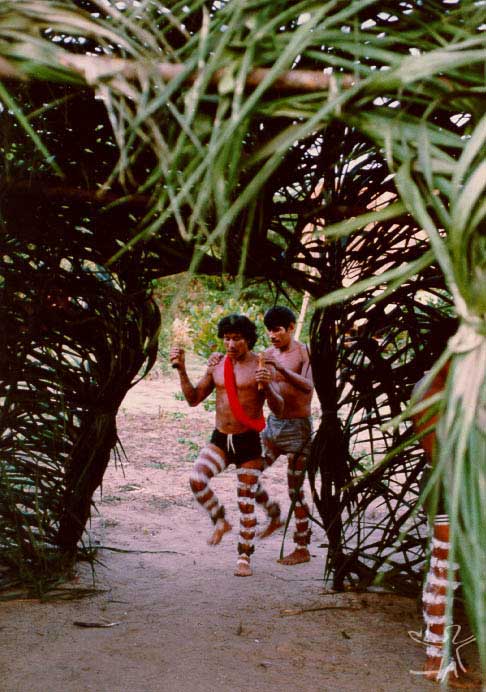
Only one space exists for the interaction of the whole village: the Tekataua - the permanent ceremonial house. It is in this ritual space that the village is enacted as a unit. There is no pre-determined site for building the Tekataua, the only stipulation is that it must be built with its front facing the east, where the Jaguar-Spirit resides. Thus its localization refers not to the Social (the village), but to the Supernatural.
The Tekataua is used only on ritual occasions and therefore does not comprise a political space. Political decisions are taken 'informally' within the sphere of the houses, without the village as a unit being activated. Politics is a dispersed activity. Occasionally a meeting between the Indians and one of FUNAI's employees visiting the village may take place in the Tekataua, but it is more usual for this to be held in the vicinity of the FUNAI post.
The Funai post amounts to a non-traditional space of social interaction, predominantly involving meetings to discuss matters concerning the indigenist body and the school. The latter involves the social interaction of children from numerous residential sections who would otherwise not live with each other on a daily basis within the village context.
Another non-traditional space is the collective flour house, built by Funai. This structure houses the ovens used to toast the flour, the manioc grinder, the grater and the tubular manioc presses. Traditionally, each nuclear family or residential section performed this task in its own space. Some families still follow this custom, but only for processing the flour consumed by themselves. Production of manioc flour for commercial ends has entailed the need to use the new infrastructure.
The Asuriní village is structured around residential sections modelled on the uxorilocal extended family. Its paradigmatic composition is therefore the head-couple, their unmarried children of both sexes and their married daughters and incoming husbands. Each residential section makes up a spatial unit, but above all an economic and political unit. Within these sections there is a regular exchange of foods, co-operation in economic activities, daily living together, and solidarity in moments of crisis, such as illnesses, fights and political disputes.
The residential section usually corresponds to a spatial configuration: clustered houses sharing a common patio. The residents of a section also share the same bathing spots on the creeks surrounding the village. This is a space of daily conviviality mainly for women who spend a good part of their day there washing clothes and eating utensils.
The location of the swiddens usually corresponds to the residential units. The residents of a same section habitually locate their swiddens close to each other. FUNAI's 'community swidden' projects slightly modified this spatial organization since, today, there is a single large swidden of manioc, rice and cacao, intended for commercial production of these crops. However, the subsistence swiddens (dedicated to the cultivation of yam, potato, banana, pineapple and maize) continue to be organized following the logic of the residential sections.
The distinctive feature of these sections is economic and political autonomy. In this sense, the Asuriní village appears to be no more than the juxtaposition of these residential units, which in daily terms operate independently. The only occasion on which the residents of different sections act in conjunction is during rituals. It is as though each residential section comprises its own village. Siblings of the opposite sex have an important role in establishing the continuity between the various residential sections. Though belonging to different units, they maintain a network of informal relations that in practice comprise the connecting link between the sections. It is these relations that, by passing through the distinct residential sections, contribute to the institution of a larger unit, namely the village.
It is also important to stress that the residential sections are fairly fluid; their particular arrangements vary over time. One of the factors behind this re-structuring is precisely the tendency for siblings of both sexes to remain united. Thus, if sister exchange or marriage of sibling sets do not lead to this situation, re-arrangements unforeseen in the formal system may take place.
Whether the head-couple is alive or not is a critical factor in such reconstitutions of a section. While the father-in-law or mother-in-law are alive, they continue to exercise power over their sons-in-law, which is reflected in the maintenance of uxorilocality.
The break-up of marriages, as well as misunderstandings between residents of a section and the wish of siblings to remain united, comprise the more common factors for the re-arrangements of the residential units - they institute a movement toward dissolving uxorilocality.
Life cycle
Every Asuriní child is conceived as the outcome of a sexual relationship between its mother and Mahira (a mythic hero), which occurs during dreaming. When she has a dream of this kind, the woman knows she is pregnant; she must then have frequent sexual intercourse with her husband in order for his semen to make the foetus grow. All the men with whom the woman has sexual relations during his period are considered biological parents of the child.
Birth takes place inside the house in the presence of women and children only, since adult men should not have contact with the blood of the woman giving birth. The woman counts on the help of one or more midwives, generally her mother. The father of the new-born will only enter the house to see the baby several hours afterwards. The placenta and the umbilical cord are buried to prevent animals from eating them, which would harm the child.
Seclusion of the mother and father until the child's umbilical cord falls off involves a series of alimentary taboos, avoidance of heavy work and confinement to the house. The new-born child should be painted with genipap in order for it to grow more quickly. For the same reason, its father should sing to it every day.
Some days after the birth, the child receives a name, generally chosen by the grandparents who know the names of the ancestors. The name is always of a dead person, but does not appear to establish any relationship between the previous owner and the child. Names refer to animals, fruits, plants and so on. Traditionally a man had three or four names. Acquisition of the second name was related to the ceremony for piercing the lower lip, which allowed the boy to use the lip decoration and penis sheath. This ritual is no longer practised and the shaman is the only man to use the lip decoration.
Young couples marry at around 15 years of age. The ideal wives for a man are considered to be his father's sister daughter (FZD) and his sister's daughter (ZD). Most marriages are monogamous, but in the 1980s the anthropologist Lúcia Andrade noted the existence of two polygamic marriages, formed earlier in the 1960s.
In marrying, the young couple as a rule go to live in the wife's parents' residential section. If it is the boy's first marriage, he will end up living in his father-in-law's actual house. After a certain period - whose limit seems to be determined by the birth of the first child - the boy builds his own house, close to his that of his wife's parents. The son-in-law must maintain a relationship of obligation to his father-in-law, which implies co-operation in economic activities, political support, as well as distance and respect. The relationship between father-in-law and son-in-law is usually cordial but formal - a distance is maintained that marks the hierarchy existing between the two. A son-in-law must collaborate with his father-in-law in economic activities such as clearing swiddens. It is also common for them to leave together on more prolonged hunting trips involving sleeping in the forest for two or three nights. However, it should be stressed that the relation does not just involve the son-in-law's provision of bride service to his father-in-law, since normally they perform the activities in conjunction. This is a form of co-operation benefiting them both. The difference lies in the father-in-law's power to call upon his son-in-law for assistance: the latter would find it difficult to refuse his father-in-law's request.
This power of summoning help becomes an even more important political power in a society such as the Asuriní's, where, for example, institutions such as a village meeting space where all the men discuss and deliberate political and economic issues are absent. There is no chiefly figure with the ability to mobilize the village as a whole.
Thus, there is no figure or institution among the Asuriní enabling the activation of the entire village for deliberation and execution of political and economic decisions. Summoning power in this society seems to be restricted to the father-in-law/son-in-law relationship and therefore to the sphere of the residential sections. As a consequence, the political status of an Asuriní man is directly linked to his daughters' marriages.
As the man becomes older, marrying his sons and surrounding himself with sons-in-law, his political influence gradually increases. The larger the number of sons-in-law a man has, the larger the contingent he will be able to mobilize.
Other sources of prestige are shamanism and, in the past, warfare activity, which in combination was further able to strengthen an individual's importance.
A man's preparation for shamanism begins when he is still young, through his participation in 'tobacco festivals.' Taking part in these rituals also ensures the biological growth of individuals. Thus, if an adolescent boy is showing difficulties in growing, his parents take him to the festival for him to dance strenuously and acquire physical strength.
The rituals contribute to an Asuriní man's biological and social development. Basic knowledge of shamanism is indispensable to the man's social formation. It is not a topic just for specialists. Thus, the power to cure may be restricted, but knowledge of and contact with the Supernatural are constituent parts of the male personality. As a result, all Asuriní men are at least to some extent shamans.
Ideological system
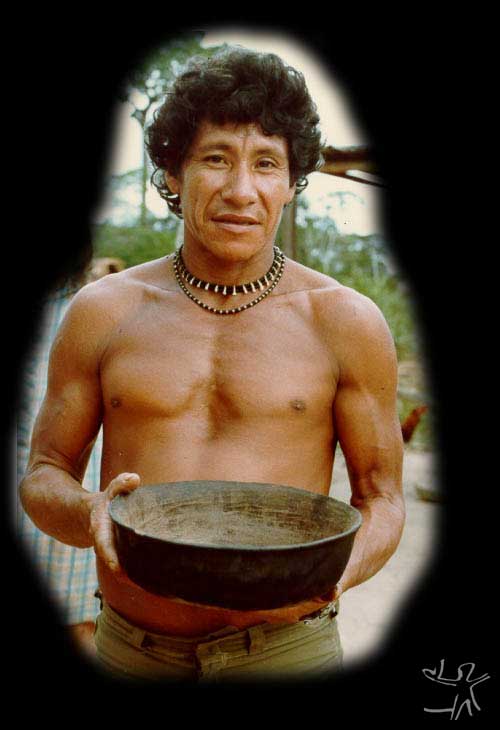
The Asuriní assert that Mahira, 'our old grandfather,' was the creator of human beings and responsible for the institution of order on the Earth. He co-ordinated the physical arrangement of the world, with tapir's help hardened the surface of the earth which was soft; separated the sky from the earth; rescued the night which was in the possession of owl, etc.
He also contributed to the establishment of Culture, transmitting basic knowledge to humans, such as cultivation of manioc, production of flutes and music. Thus, as an Asuriní man explained: "everything that was invented by Indians was taught by Mahira."
At the time of origins, Mahira lived in the village with the Asuriní. There he had a wife and a daughter. His daughter never succeeded in remaining married for long since Mahira became infuriated with his sons-in-law and, smoking his tawari, transformed them into animals. Such behaviour ended up forcing Mahira to move away from the village, since the humans became extremely angry with him.
Finally, the Asuriní started to plan to kill Mahira and he decided to return to the sky: "There was an enormous storm, strong winds and rain, and he was lifted up. He tried to hold onto a tree stump to prevent himself rising, then another, until finally the wind caught hold of him. He then let go of his arm and he was carried away." It was after Mahira's return to the heavens that the first sicknesses appeared among humans; previously no-one had become ill and there were no shamans.
Today, Mahira and his wife live in the sky, in a place called Tapana. This is also the same place where the dead go: "whoever dies builds another house there, people say there are many. Whites also go there. There every caboclo who died also lives." According to the Asuriní, the place where Mahira dwells also has a sky, sun and moon: "it has everything that we have here. There are game animals above, Mahira hunts. There are many people there above, swiddens too, it has everything."
And from there above, Mahira continues to follow the life of humans on the Earth, continuing to fulfil his role as Creator. As already seen, Mahira is the father of all the Asuriní. He not only begets all children, he also takes zealous care of his offspring. Thus, if a child is continually maltreated by his or her mother, Mahira 'lets her ascend:' he makes her ill, die and go to live with him. As he 'likes' his children so much he stops them from being maltreated. Therefore Mahira has the power and life and death over humans. And their life is nothing more than a circle that begins and ends with Mahira: humans are born from him and go to live with him after death.
The Asuriní conceive the supernatural world to be divided into two independent spheres: that of Mahira and that of Sawara (the Jaguar-spirit). Mahira's domain relates to the cycle of life and death, the biological reproduction of humans: it is associated with the sky and with women - the only people on the Earth who maintain a relationship with Mahira, through sexual acts taking place in dreams. The sphere of Sawara relates to shamanism and the belief in the possibility of the rebirth of shamans; it is associated with the forest and the male universe.
Shamanic activity among the Asuriní is fairly intense and has a great deal of importance. For a man to become a shaman it is necessary for him to traverse a path filled with dangers in his dreams until he reaches Sawara, the Jaguar-spirit. It is by contacting Sawara that he will receive the Karowara and thus the power to cure sickness.
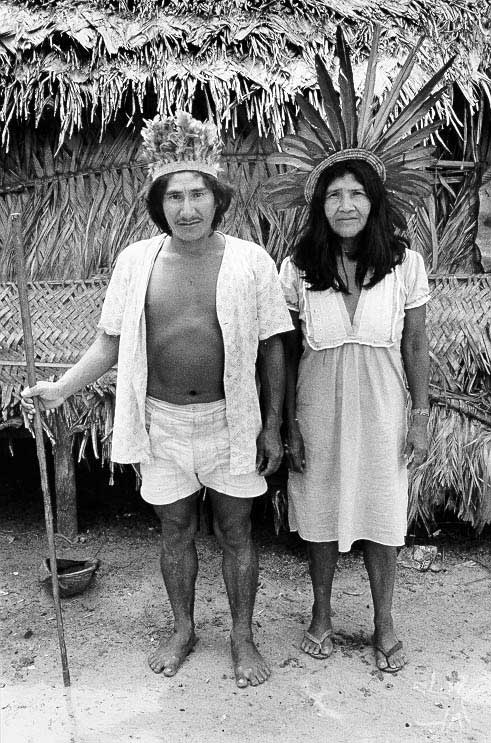
However, for this dream to become concrete the apprentice must undergo a lengthy process enabling him to deal with the supernatural forces and improve his knowledge concerning myths and music. The core phase of this apprenticeship is the tobacco festivals, where the novices are brought into contact with the Karowara. These rituals also contain moments dedicated to learning the mythic histories and songs, recited and sung by the shaman. This procedure complements a process informally started in each individual's house, where it is possible to hear parents and grandparents telling "stories of the ancient past".
The tobacco festivals are co-ordinated by a shaman. It is he who decides the moment for them to be performed, very often in response to a request from another man wishing to dance. According to the Asuriní, the shaman is concerned to ensure that the men dance from time to time so "not to forget."
The shaman is the specialist responsible for treating illnesses provoked by the Karowara. However, Asuriní aetiology also combines another category of infirmity whose cure is not restricted to the shamanic sphere, although they should also be familiar with the technique involved in these treatments. It is not this knowledge that qualifies the individual to act as a shaman, but a good professional should seek to be fully acquainted with these procedures. On the other hand, this knowledge is a source of prestige for other Asuriní and in general it is older people who possess it.
Asuriní aetiology distinguishes, then, two basic categories of sickness. On one hand, those that result from contact with the Supernatural (the Karowara sicknesses) and on the other hand all the other known diseases. Included in this second class are those classified as "White/Christian sicknesses" (influenza, measles, pneumonia, chicken pox, etc.), which should be treated in the FUNAI infirmary or the hospital in the city of Tucuruí. When the shaman diagnoses a disease in this subcategory, he recommends that the patient seeks out the nurse, who in fact "only really know how to cure this type of sickness."
Figuring alongside the 'White illnesses' in this second category are afflictions cured with medicinal plants. These diseases are usually diagnosed and treated within the family setting by the sick person him or herself (when an adult) or by a close kinsperson. The use of such plants is fairly widespread, although older people have accumulated more knowledge in this area.
The Asuriní cite recipes for curing a large variety of illnesses, such as: malaria, fevers, toothaches, headaches, tocandira ant wounds, worms, snake bites, dysentery, coughing, spider bites, cuts, wounds, earaches and throat sores. The method of employing the plants is also varied: leaves, stems or the liquid extracted from the plant may all be used. The plants may be applied directly on the body where the pain is located. Otherwise, a bath is prepared with the leaves, or the plant is cooked in water for the patient to ingest the liquid.
It is common for sick people to resort to these home-made remedies before seeking the shaman's help. If the affliction is not cured by this treatment, the family concludes it may be a Karowara sickness and resorts to the shaman for a diagnosis; this is fairly usual in the case of headaches and fevers. On the other hand, the use of medicinal plants does not eliminate the simultaneous use of remedies supplied by FUNAI, especially if the sick person is a child.
The Karowara are an important supernatural force circling between humans and supernatural beings, through actions involving co-operation or aggression. The Karowara are equally a source of power for shamans (who deliberately contain them inside their bodies) and the cause of sickness.
In the latter case, the Karowara are projected into humans by the Takwitimasa, a category of supernatural beings dwelling in the forest. One reason mentioned for this aggressive procedure of the Takwitimasa against humans concerns the latter's aggression against animals. Thus, the Takwitimasa are said to throw Karowara at humans when the latter mistreat animals.
Shamans have the power to remove the Karowara inserted by the Takwitimasa into humans, as well as the ability to place them inside their own human bodies during the process of training a shaman.
As mentioned above, the acquisition of this power depends on a third form of receiving Karowara via the Jaguar-spirit (Sawara). At the same time, it is the relationship with this spirit which will confer the man with the potential for resurrection. The Asuriní believe that if the shaman's body is buried in compliance with particular procedures, whose execution falls to the responsibility of women, he will be resuscitated. Rebirth is the ideal fate for men.
This possibility does not apply to women: at death they must go to Tapana, where Mahira is found. Female existence obeys, then, a cyclical movement that starts and finishes with Mahira.
Note on the sources
The Asuriní began to be studied in the 1960s. During this period, research into the Asuriní language was begun by members of the Summer Institute of Linguistics: Carl Harrison, Robin Solly, Velda Nicholson, Catherine Aberdour and Anette Tomkins. These surveys continued until the 1970s, resulting in publications such as Gramática Asuriní written by Harrison (SIL, 1980), as well as Emogeta: Cartilha Asuriní (1977) and Aspectos da Língua Asurini (1978), both produced by Nicholson and published by SIL.
The 1960s also saw the start of anthropological research by Roque Laraia and Expedito Arnaud. During this period, Arnaud published a number of articles providing general information concerning the group, referring to contact, kinship terminology and subsistence activities.
Roque Laraia undertook his research among the Asuriní in 1962, staying with them for a period of four months. On this occasion, the community suffered the consequences of a tragic process of depopulation, a result of successive epidemics brought in the wake of 'pacification.' This, the group of 190 individuals contacted in 1953 was by 1962 reduced to 34 Indians living at the SPI post, 10 scattered among non-Indians and 14 in the forest - the latter made up the Pacajá group, with whom Laraia had no contact.
The enormous population loss experienced by the Asuriní on one hand, and Laraia's theoretico-methodological approach on the other, explain why he did not produce a specific and detailed monograph on the Asuriní. His research was included in the 'Areas of Interethnic Friction' project, directed by Roberto Cardoso de Oliveira: its results were published in the article A Fricção Interétnica no Médio Tocantins (1964) and the book Índios e Castanheiros, which the author published in 1967 in co-authorship with Roberto da Matta. In these works, the main information on the Asuriní concerns their history of contact. Data on social organization is restricted to kinship terminology and marriage rules, which are analyzed by the author.
Another concern which guided Laraia's works was the comparative perspective. Thus, his decision to work with the Asuriní stemmed from information indicating their similarity with the Suruí, among whom Laraia had already pursued research. The result of this comparative study can be found in the author's article Akuáwa-Asuriní e Suruí - Análise de Dois Grupos Tupi (1972), which also provides short but previously unpublished information on Asuriní material culture, economic activities and shamanism.
The comparative perspective is also present in his doctoral thesis Organização Social dos Tupi Contemporâneos, presented in 1972 and published under the title Tupi: índios do Brasil atual. As could be expected from a comparative work, the information on the indigenous groups are generalized. The author does not approach the Asuriní cultural system as a whole, as this would only be possible in a specific monograph on this group. Even so, it is in his thesis that Laraia provides the largest amount of data on the Asuriní, approaching other aspects of social organization beyond the kinship terminology and marriage rules analyzed in earlier works.
More recently in the 1980s, the Asuriní were studied by the anthropologist Lúcia Andrade. This research took place in the context of the renewed studies of Tupi Peoples, undertaken by a series of anthropologists from various teaching and research institutions among Tupi groups in Amazonia only recently contacted at the time, and also among other already known peoples such as the Asuriní. Lúcia Andrade undertook field research between 1982 and 1989 which resulted in her master's dissertation O Corpo e o Cosmos, Relações de Gênero e o Sobrenatural entre os Asuriní do Tocantins presented to the Department of Social Anthropology at the University of São Paulo in 1992. The dissertation examines two central themes, shamanism and gender relations, which provide the basis for an analysis of Asuriní cosmology and their notion of the Person.
Sources of information
- ANDRADE, Lúcia Mendonça Morato de. O corpo e o cosmos : relações de gênero e o sobrenatural entre os Asurini do Tocantins. São Paulo : USP, 1992. (Dissertação de Mestrado)
- ARNAUD, Expedito. Mudanças entre os grupos indígenas Tupi da região do Tocantins-Xingu (Bacia Amazônica). In: --------. O índio e a expansão nacional. Belém : Cejup, 1989. p. 315-64. Publicado originalmente no Boletim do MPEG, Antropologia, Belém, n.s., n. 84, abr. 1983.
- HARRISON, Carl. Gramática Asurini. Brasília : SILK, 1980.
- LARAIA, Roque de Barros. Akwáwa-Asurini e Suruí : análise de dois grupos Tupí. Rev. do Instituto de Estudos Brasileiros, São Paulo : IEB, v. 12, p. 7-30, 1972.
- --------. Tupí : índios do Brasil atual. São Paulo : USP, 1986. (Antropologia, 11)
- --------; MATTA, Roberto da. Índios e castanheiros : a empresa extrativista e os índios no Médio Tocantins. Rio de Janeiro : Paz e Terra, 1978. 208 p. (Estudos Brasileiros, 35)
- NICHOLSON, Velda. Emogeta : cartilha Asurini. Brasília : SIL, 1977.
- --------. Aspectos da língua Asurini. Brasília : SIL, 1978.
- SILVA, C. E.; Carvalho Junior, J.; Miller, R. P. Avaliação de impacto ambiental e sociocultural da UHE Tucuruí na Terra Indígena Trocará – Povo Asuriní & Proposta de ação compensatória. Associação de Apoio às Atividades do Programa Parakanã - AAPP, 2006, 190 p. (relatório não publicado).
- SOARES, Marília Lopes da Costa Facó. A perda da nasalidade e outras mutações vocálicas em Kokama, Asurini e Guajajara. Rio de Janeiro : UFRJ, 1979. (Dissertação de Mestrado)